OtGO: The Ground as a Site of Memory
-- The original text in Spanish --
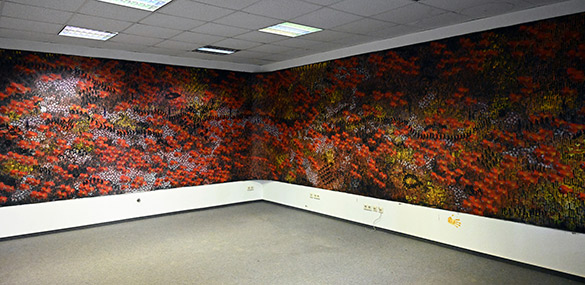
OtGO (Otgonbayar
Ershuu)
Slavery Narratives: The Atlantic Slave Trade & The Native Americans, 2013-2023 Acrylic on canvas, 215 x 1.000 cm
work in progress – YouTube: https://youtu.be/F_Rr5YlGYRA?si=LvNuKBeKE2i_ffsA
by Regina Esquenazi Levy
Paris, France 2026
Referencias
1. Steinberg, Leo. “The Flatbed Picture Plane.” In Other Criteria: Confrontations with Twentieth-Century Art, 61-98. New York: Oxford University Press, 1972.
2. Rosenberg, Harold. The Tradition of the New. New York: Horizon Press, 1959.
3. Beaux Arts Magazine. “Ce que vous ne saviez peut-être pas sur Jackson Pollock.”
(https://www.beauxarts.com/grand-format/ce-que-vous-ne-saviez-peut-etre-pas-sur-jackson-pollock/)
4. OtGO (Otgonbayar Ershuu). Questionnaire by Regina Esquenazi Levy. Email correspondence, 4 October 2026. Material provided by the artist, courtesy of OtGO
5. OtGO (Otgonbayar Ershuu). “Inside the Studio: Behind the Curtain: Origin and Creation of Painting.” YouTube video, 13 May 2021.
https://youtu.be/F_Rr5YlGYRA?si=E8ELucZUdhod20Cd
work in progress – YouTube: https://youtu.be/LT-O6GZ4t14?si=BQr9eIaKGmW1M3fG
Regina Esquenazi Levy – Questions: Slavery Narratives
OtGO (Otgonbayar Ershuu)
Slavery Narratives: The Atlantic Slave Trade & The Native Americans, 2013-2023 Acrílico sobre lienzo, 215 x 1.000 cm
-- The original text in Spanish --
Regina Esquenazi Levy

Slavery Narratives: The Atlantic Slave Trade & The Native Americans, 2013-2023 Acrylic on canvas, 215 x 1.000 cm
In
1950, Hans Namuth photographed and filmed Jackson Pollock painting on
the floor of his barn in Springs. The images offered a different way of
understanding the act of painting: rather than working in front of a
canvas, Pollock moved around it, leaning over the surface and
approaching it from all four sides. Pollock explained that working on
the floor made him feel closer to the painting. In 1952, critic Harold
Rosenberg described the canvas as an arena for action. In the
mid-1950s, Kazuo Shiraga, a member of Japan’s Gutai group, took this
physical relationship with the material further, painting with his feet
while suspended from a rope above canvases spread across the floor.
OtGO shares this physical approach to painting, although he says he
took no references from other artists. In Slavery Narratives,
the ground takes on a different meaning: it becomes a site of memory, where
the act of painting becomes a way of engaging with the past.
work in progress – YouTube: https://youtu.be/F_Rr5YlGYRA?si=LvNuKBeKE2i_ffsA
Born in
Ulaanbaatar, Mongolia, in 1981, OtGO studied traditional Mongolian
painting and learned the techniques and iconography of miniature
painting in Buddhist-Lamaist monasteries before continuing his
education at the Universität der Künste in Berlin. Created between
2013 and 2023, Slavery Narratives
emerged from his research into the histories of Indigenous peoples in
North America and the transatlantic slave trade. He was struck by how
little he knew about these histories and became deeply affected by the
suffering endured by those who lived through them. He also questions
why these histories remain largely overlooked. For OtGO, their
connection is not one he needs to construct deliberately; it is already
rooted in history itself, even if the two are often treated separately.
The painting brings these histories into dialogue without presenting them as interchangeable. Through human figures, animals and painterly traces, OtGO evokes the consequences of colonial violence without seeking to provide a linear historical account. Created on a canvas laid flat on the floor, the work can be read as a plain, the hold of a slave ship or a site of memory. As the artist walks barefoot across its surface, painting becomes a physical encounter with the ground, inviting viewers to engage more closely with the histories and human experiences the work brings into view.
Audiovisual documentation of the process lets us reconstruct its main stages. The black canvas lies on the floor, with bowls of paint arranged around it. OtGO begins by pouring thin threads of red paint onto the dark surface, tracing outlines across it. Violet splashes follow, along with bursts of yellow. He then crouches down, moves onto all fours and spreads the colours with his palms, fingers and feet. White and orange swirls begin to emerge, earthy pinks and ochres develop, and dark veins of the ground remain visible between the layers. Handprints in black, yellow, white and red are scattered across the canvas. They function as pictorial units, helping to build the figures as well as the overall texture of the work.
work in progress – YouTube: https://youtu.be/m5FUPsXmKNQ?si=XNIwtqtH1WQfXaHr
These physical gestures also shape the way the canvas functions as a pictorial surface. In a lecture given at MoMA in 1968 and published in 1972, art critic Leo Steinberg introduced the term flatbed picture plane to describe a horizontal surface that receives the artist's actions and retains their traces. Slavery Narratives gives this idea a very physical form: the movements involved in making the painting do not disappear beneath the finished image but remain inscribed in it.
Among the figures in the composition, the yellow-toned face of an older man stands out, rendered through fine lines and layers of paint. His direct gaze establishes an immediate encounter with the viewer. “It is a monument to these figures. The faces are portraits of people who survived,” OtGO explains. He drew on historical photographs to represent survivors, giving individual faces to histories marked by suffering and loss. Elsewhere, fingertip impressions form the fur of an animal with pale eyes; the accumulation of small marks gradually gives shape to a recognisable figure. As the artist explains, the imprints of his hands and feet mean that the painting is not simply something he has created, but also a part of himself.
The bison hold a significant place in the composition. For many Indigenous communities of the Great Plains, these animals were essential to survival and cultural life. Their mass slaughter in the nineteenth century helped destroy those ways of life and was part of a wider process of colonial dispossession. By bringing together bison, skulls and human bodies, OtGO links violence against people to the destruction of what sustained their communities. Yet African enslavement and the colonisation of Indigenous peoples have distinct historical contexts and consequences. The painting brings these histories into dialogue without erasing their differences.
The scale of the work reinforces its commemorative purpose. At ten metres long, Slavery Narratives is far larger than a conventional painting and can't be taken in from a single viewpoint. OtGO says he chose this format to make an overlooked history visible and to make sure it would be taken seriously. When it is installed around the walls of a room, the canvas surrounds the viewer. Seeing it means moving: you walk along it, stop at the details and step back to see how the figures relate to one another. This fits the artist's description of the image as infinite, as if it continued beyond the frame. The work can't be grasped all at once; it unfolds as you move through the space.
work in progress – YouTube: https://youtu.be/KRMMbkyS6gU?si=DtEbRvMMGTNfPJkO
The most intimate trace comes at the end. When the painting was finished, OtGO dipped the fingers of his right hand in black paint and left their prints on the canvas, thinking of the souls of the victims and hoping to offer them some consolation. He believes that the death of the body doesn't mean the soul disappears, and that is how he understands this gesture. He also explains that, because the canvas bears the marks of his hands and feet, it is not simply something he has made, but a part of himself. For OtGO, painting is as much a spiritual act as it is a record of history.
The work belongs to a broader body of research that includes the triptych The Galleys of Souls (2013-2021). After more than thirteen years on this subject, OtGO says he needed to make these images to find calm again, his words show how personal the project is, while the painting itself reaches beyond his own experience.
In Slavery Narratives, the artist's traces live alongside the figures he wants to remember. The painting records a physical process and offers an interpretation of the past. Making a history visible, however, does not mean it has been understood. By bringing together the marks of the body, the faces of survivors and the figures linked to the destruction of their communities, OtGO creates a space of memory that invites viewers to move through the work and look again. The painting leaves us with a question that goes beyond its subject: how do we keep alive the memory of those who suffered without reducing their stories to the images through which we remember them?
The painting brings these histories into dialogue without presenting them as interchangeable. Through human figures, animals and painterly traces, OtGO evokes the consequences of colonial violence without seeking to provide a linear historical account. Created on a canvas laid flat on the floor, the work can be read as a plain, the hold of a slave ship or a site of memory. As the artist walks barefoot across its surface, painting becomes a physical encounter with the ground, inviting viewers to engage more closely with the histories and human experiences the work brings into view.
Audiovisual documentation of the process lets us reconstruct its main stages. The black canvas lies on the floor, with bowls of paint arranged around it. OtGO begins by pouring thin threads of red paint onto the dark surface, tracing outlines across it. Violet splashes follow, along with bursts of yellow. He then crouches down, moves onto all fours and spreads the colours with his palms, fingers and feet. White and orange swirls begin to emerge, earthy pinks and ochres develop, and dark veins of the ground remain visible between the layers. Handprints in black, yellow, white and red are scattered across the canvas. They function as pictorial units, helping to build the figures as well as the overall texture of the work.
work in progress – YouTube: https://youtu.be/m5FUPsXmKNQ?si=XNIwtqtH1WQfXaHr
These physical gestures also shape the way the canvas functions as a pictorial surface. In a lecture given at MoMA in 1968 and published in 1972, art critic Leo Steinberg introduced the term flatbed picture plane to describe a horizontal surface that receives the artist's actions and retains their traces. Slavery Narratives gives this idea a very physical form: the movements involved in making the painting do not disappear beneath the finished image but remain inscribed in it.
Among the figures in the composition, the yellow-toned face of an older man stands out, rendered through fine lines and layers of paint. His direct gaze establishes an immediate encounter with the viewer. “It is a monument to these figures. The faces are portraits of people who survived,” OtGO explains. He drew on historical photographs to represent survivors, giving individual faces to histories marked by suffering and loss. Elsewhere, fingertip impressions form the fur of an animal with pale eyes; the accumulation of small marks gradually gives shape to a recognisable figure. As the artist explains, the imprints of his hands and feet mean that the painting is not simply something he has created, but also a part of himself.
The bison hold a significant place in the composition. For many Indigenous communities of the Great Plains, these animals were essential to survival and cultural life. Their mass slaughter in the nineteenth century helped destroy those ways of life and was part of a wider process of colonial dispossession. By bringing together bison, skulls and human bodies, OtGO links violence against people to the destruction of what sustained their communities. Yet African enslavement and the colonisation of Indigenous peoples have distinct historical contexts and consequences. The painting brings these histories into dialogue without erasing their differences.
The scale of the work reinforces its commemorative purpose. At ten metres long, Slavery Narratives is far larger than a conventional painting and can't be taken in from a single viewpoint. OtGO says he chose this format to make an overlooked history visible and to make sure it would be taken seriously. When it is installed around the walls of a room, the canvas surrounds the viewer. Seeing it means moving: you walk along it, stop at the details and step back to see how the figures relate to one another. This fits the artist's description of the image as infinite, as if it continued beyond the frame. The work can't be grasped all at once; it unfolds as you move through the space.
work in progress – YouTube: https://youtu.be/KRMMbkyS6gU?si=DtEbRvMMGTNfPJkO
The most intimate trace comes at the end. When the painting was finished, OtGO dipped the fingers of his right hand in black paint and left their prints on the canvas, thinking of the souls of the victims and hoping to offer them some consolation. He believes that the death of the body doesn't mean the soul disappears, and that is how he understands this gesture. He also explains that, because the canvas bears the marks of his hands and feet, it is not simply something he has made, but a part of himself. For OtGO, painting is as much a spiritual act as it is a record of history.
The work belongs to a broader body of research that includes the triptych The Galleys of Souls (2013-2021). After more than thirteen years on this subject, OtGO says he needed to make these images to find calm again, his words show how personal the project is, while the painting itself reaches beyond his own experience.
In Slavery Narratives, the artist's traces live alongside the figures he wants to remember. The painting records a physical process and offers an interpretation of the past. Making a history visible, however, does not mean it has been understood. By bringing together the marks of the body, the faces of survivors and the figures linked to the destruction of their communities, OtGO creates a space of memory that invites viewers to move through the work and look again. The painting leaves us with a question that goes beyond its subject: how do we keep alive the memory of those who suffered without reducing their stories to the images through which we remember them?
by Regina Esquenazi Levy
Paris, France 2026
Referencias
1. Steinberg, Leo. “The Flatbed Picture Plane.” In Other Criteria: Confrontations with Twentieth-Century Art, 61-98. New York: Oxford University Press, 1972.
2. Rosenberg, Harold. The Tradition of the New. New York: Horizon Press, 1959.
3. Beaux Arts Magazine. “Ce que vous ne saviez peut-être pas sur Jackson Pollock.”
(https://www.beauxarts.com/grand-format/ce-que-vous-ne-saviez-peut-etre-pas-sur-jackson-pollock/)
4. OtGO (Otgonbayar Ershuu). Questionnaire by Regina Esquenazi Levy. Email correspondence, 4 October 2026. Material provided by the artist, courtesy of OtGO
5. OtGO (Otgonbayar Ershuu). “Inside the Studio: Behind the Curtain: Origin and Creation of Painting.” YouTube video, 13 May 2021.
https://youtu.be/F_Rr5YlGYRA?si=E8ELucZUdhod20Cd
work in progress – YouTube: https://youtu.be/LT-O6GZ4t14?si=BQr9eIaKGmW1M3fG
Regina Esquenazi Levy – Questions: Slavery Narratives
Berlin – Paris
on October 2, 2026
on October 2, 2026
OtGO (Otgonbayar Ershuu)
Slavery Narratives: The Atlantic Slave Trade & The Native Americans, 2013-2023 Acrílico sobre lienzo, 215 x 1.000 cm
1.
What inspired you to create this work, and why did you decide to bring
together the histories of Native Americans and the transatlantic slave
trade?
I don’t plan an image; the images come to me. That is why I don’t go looking for inspiration. I read non-fiction—I enjoy true stories and history. At one point, I read about the history of Native Americans alongside that of the transatlantic slave trade, and I was astonished at how little I knew about it. I assume there are many people who want to deliberately keep this history invisible. I didn’t link these two tragic fates myself; that connection already existed in history. Unfortunately, however, people tend to discuss these histories separately.
2. Are there any artists, artistic traditions, books, photographs, films, or other references that influenced or inspired this work?
No.
Once that previously unseen story became visible to me, I could not free myself from it; my soul was restless, and I often thought of the strangers who had died such painful deaths. In reality, I am a very calm person. I firmly believe that people never truly die—only their bodies do. The soul exists somewhere; there are no limitations of time or space.
So, starting this painting was not a conscious decision; rather, I had already begun creating these works in my subconscious long before.
3. How do you see the relationship between the spontaneous gestures, dripping, and handprints, and the more figurative elements of the painting?
Because it bears my footprints and handprints, the painting was not merely created by me—it is a part of me.
Since I created it unconsciously, there are no spontaneous gestures involved at all. It was a spiritual act. I am neither white nor black; therefore, I can approach this subject with great neutrality.
4. Could you tell me more about the recurring elements in the composition (the human figures, faces, bison, etc.) What do they represent to you?
It is a monument to these figures. By the way, the faces are portraits of surviving people.
5. Why was it important for you to create the work on such a large scale and surround the viewer with it?
I wanted to make this invisible history visible. It deals with a very serious subject; that is why I chose a large format—so that it would be taken seriously. The image is infinite and seems to continue endlessly beyond the frame.
6. How does this work relate to your broader artistic practice, and what would you like the viewer to feel or take away from it today?
I also created a work with this topic. It's a triptych. "The Galleys of Souls" I want to raise awareness of this story. We should treat this history with respect to ensure that this history is not repeated in any way. After more than 13 years of intensive mission with this topic, now these images are behind me rather than in front of me. I feel that I needed to create them so that my soul could return to a state of calm. I am happy now.
Triptych: The GALLEYS of SOULS by OtGO 2013–2021 acryl on canvas 215 x 1000 cm
I don’t plan an image; the images come to me. That is why I don’t go looking for inspiration. I read non-fiction—I enjoy true stories and history. At one point, I read about the history of Native Americans alongside that of the transatlantic slave trade, and I was astonished at how little I knew about it. I assume there are many people who want to deliberately keep this history invisible. I didn’t link these two tragic fates myself; that connection already existed in history. Unfortunately, however, people tend to discuss these histories separately.
2. Are there any artists, artistic traditions, books, photographs, films, or other references that influenced or inspired this work?
No.
Once that previously unseen story became visible to me, I could not free myself from it; my soul was restless, and I often thought of the strangers who had died such painful deaths. In reality, I am a very calm person. I firmly believe that people never truly die—only their bodies do. The soul exists somewhere; there are no limitations of time or space.
So, starting this painting was not a conscious decision; rather, I had already begun creating these works in my subconscious long before.
3. How do you see the relationship between the spontaneous gestures, dripping, and handprints, and the more figurative elements of the painting?
Because it bears my footprints and handprints, the painting was not merely created by me—it is a part of me.
Since I created it unconsciously, there are no spontaneous gestures involved at all. It was a spiritual act. I am neither white nor black; therefore, I can approach this subject with great neutrality.
4. Could you tell me more about the recurring elements in the composition (the human figures, faces, bison, etc.) What do they represent to you?
It is a monument to these figures. By the way, the faces are portraits of surviving people.
5. Why was it important for you to create the work on such a large scale and surround the viewer with it?
I wanted to make this invisible history visible. It deals with a very serious subject; that is why I chose a large format—so that it would be taken seriously. The image is infinite and seems to continue endlessly beyond the frame.
6. How does this work relate to your broader artistic practice, and what would you like the viewer to feel or take away from it today?
I also created a work with this topic. It's a triptych. "The Galleys of Souls" I want to raise awareness of this story. We should treat this history with respect to ensure that this history is not repeated in any way. After more than 13 years of intensive mission with this topic, now these images are behind me rather than in front of me. I feel that I needed to create them so that my soul could return to a state of calm. I am happy now.
Triptych: The GALLEYS of SOULS by OtGO 2013–2021 acryl on canvas 215 x 1000 cm

Detailed view: Slavery Narratives: The Atlantic slave trade & The Native Americans
work in progress – YouTube: https://youtu.be/60KpRmBaYJQ?si=9ROCqayeqpdSiYt-
Please also look at this picture:
Triptych: The GALLEYS of SOULS by OtGO 2013–2021 acryl on canvas 215 x 1000 cm
